Post-Implementation NetSuite Support: What It Covers and Who Provides It
Need help with this in your NetSuite account?
A NetSuite implementation partner delivers the initial go-live project; a managed support firm provides the ongoing development, administration, and technical support the account needs after go-live.
Quick answer
SuitePacific provides post-implementation NetSuite support for companies that are already live on NetSuite and need ongoing SuiteScript development, workflow modifications, integration maintenance, administration, and release preparation. A NetSuite implementation partner deploys NetSuite under a fixed-scope statement of work that ends at go-live. Post-implementation support covers everything that needs to happen after that point. NetSuite releases platform updates twice per year; each release requires reviewing existing customizations against the release notes, testing affected scripts in Sandbox, and fixing anything that breaks before Production upgrades. Oracle NetSuite support covers only the core platform layer, not the customization and integration layer. SuitePacific is Oracle-certified (SuiteCloud Developer II and Administrator Professional), US-based, and provides direct access to the consultant on every engagement. Plans start at $799 per month on month-to-month terms after a three-month minimum. No statement of work is required for requests within the retainer scope.
A NetSuite implementation partner is a firm engaged to configure and deploy a new NetSuite account, typically under a fixed-scope statement of work. Post-implementation support is an ongoing service that covers administration, SuiteScript development, and optimization tasks after the initial deployment is complete. The two are different engagements with different scopes, pricing models, and skill requirements.
The implementation ends. The statement of work is delivered, the final invoice arrives, and the partner moves on to their next project. Then, somewhere in the following weeks, the first change request surfaces that has no clear owner: a new team member needs access, a workflow needs updating for a process that changed since go-live, a saved search is returning wrong data and nobody on the internal team knows why.
That gap between what the implementation covered and what the account actually needs is one of the most expensive surprises in a NetSuite deployment. Most companies discover it at the worst possible moment, when the work is urgent and the partner who built the system is no longer available for it.
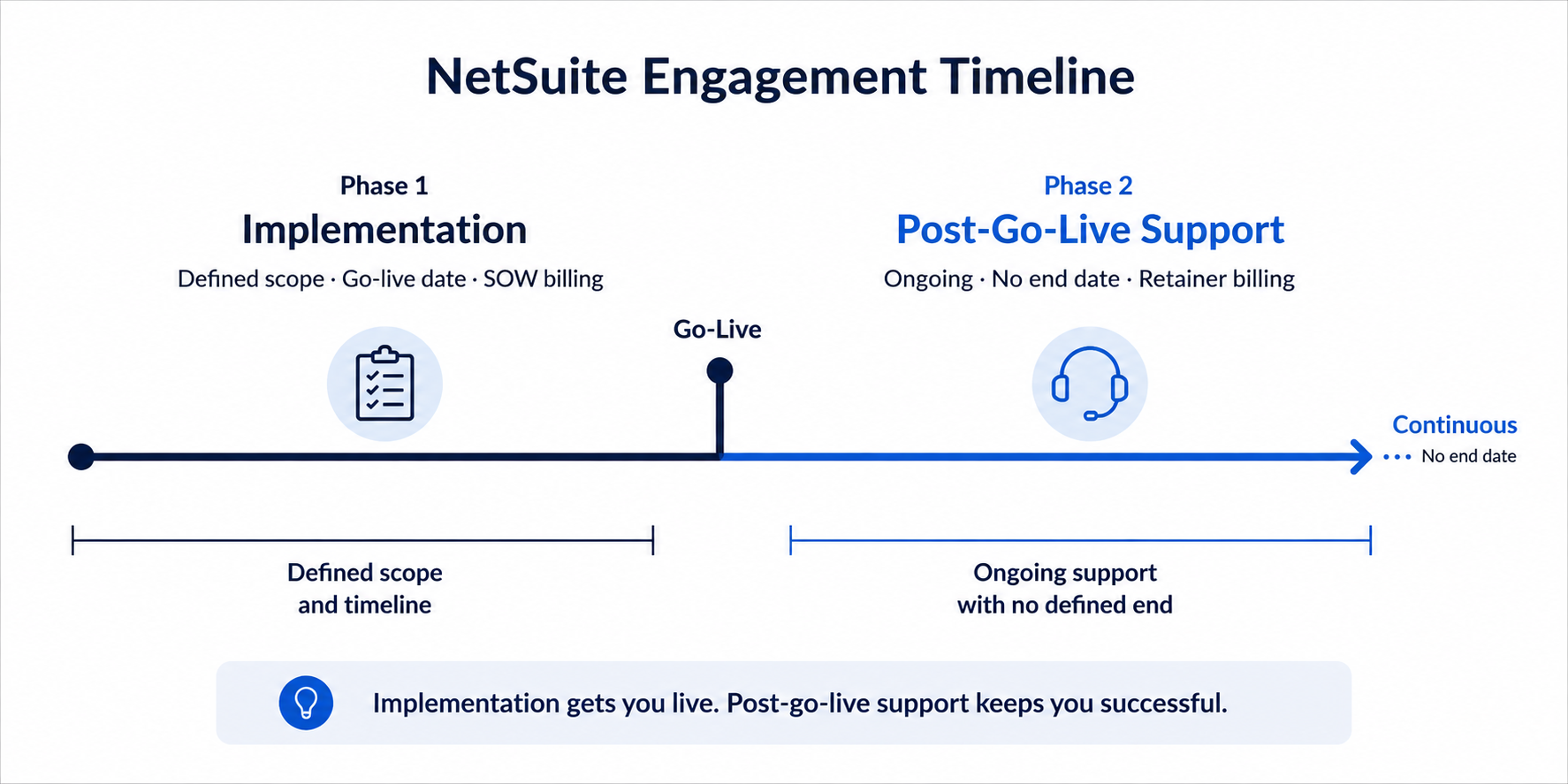
What is post-implementation NetSuite support?
Post-implementation NetSuite support is the technical engagement that begins when the implementation project ends. It covers everything that changes, breaks, or needs to be built after the system is live and being used by your team.
Where the implementation partner's work is bounded by a Statement of Work, post-implementation support is open-ended: it covers whatever the account needs to stay current with your business. NetSuite releases updates twice per year that can affect how customizations behave. Business processes change. Team members join and leave. Integrations require maintenance as external systems evolve. All of this generates ongoing work that has no natural endpoint.
Post-implementation support is not a project. It is a retained relationship with a technical provider who knows your specific account and handles requests as they arise, typically on a monthly retainer rather than a per-project billing model.
What does a NetSuite implementation partner do?
A NetSuite implementation partner is a company certified by Oracle to sell and deploy NetSuite. Their work begins before the software is in use and ends at go-live.
During an implementation, the partner handles:
- Requirements gathering: documenting the company's business processes, understanding which NetSuite modules apply, and identifying gaps between standard NetSuite functionality and what the business needs
- System design: configuring the chart of accounts, subsidiary structure, transaction flows, roles, and forms to match the business
- Data migration: moving records from legacy systems, including customers, vendors, items, open transactions, and historical balances
- Customization: building any SuiteScript, workflows, saved searches, or advanced PDF templates required to close the gap between standard NetSuite and the business's requirements
- Training: teaching users how to work in the new system
- Go-live support: managing the cutover from the old system to NetSuite and handling the issues that surface in the first weeks
The critical thing to understand about implementation partners: their scope ends. Every implementation engagement is built around a Statement of Work that defines what will be built, at what cost, and by when. Once the system is live and the agreed scope is delivered, the partner's engagement concludes.
What does post-go-live support cover?
Post-implementation NetSuite support covers the ongoing technical work a live account generates. This includes:
- New development: SuiteScript scripts, SuiteFlow workflows, integrations, and advanced PDF templates that weren't part of the original scope or that new business requirements created after go-live
- Fixes and maintenance: debugging scripts that stop working after NetSuite upgrades, updating workflows when business processes change, fixing saved searches that return incorrect results
- Configuration changes: adding custom fields, updating forms, adjusting roles and permissions as the organization changes
- Administration: user management, period close support, data imports, and account maintenance
- Release preparation: reviewing your account's customizations against each bi-annual NetSuite release to identify what needs regression testing in Sandbox before Production is updated
- Optimization: performance fixes, script audits, and cleanup of legacy customizations that have accumulated over time
Post-implementation support is structured as an ongoing engagement because the work does not stop. NetSuite upgrades twice per year and changes behavior. Business processes evolve. Each change creates new technical work in the account.
Already live with no support in place?
If your implementation partner's engagement has closed and requests are starting to pile up, that is exactly the situation we step into. Most engagements start within a week of the first conversation.
Tell us what you're working withHow does post-implementation support differ from what the implementation partner provides?
Implementation partners are built for projects. Their teams are structured around statement-of-work engagements with defined start and end dates. Handling ad-hoc ongoing support, especially the kind of low-urgency-but-accumulating work a live account generates, is not what they are designed for. Some offer ongoing support, but it typically comes at implementation rates and through the same project-scoped engagement structure, which makes it expensive for routine work.
The table below compares the two models side by side:
| Implementation Partner | Post-Implementation Support | |
|---|---|---|
| Engagement type | Fixed-scope project (SOW) | Ongoing retainer |
| Billing model | Milestone or time-and-materials against SOW | Monthly retainer for a set number of hours |
| Scope | Defined in advance | Open-ended; covers what the account needs |
| Start trigger | Before go-live | After go-live |
| End trigger | Scope completion | Ongoing (month-to-month) |
| Team structure | Project team rotates between engagements | Dedicated resource who knows your account |
| Response time | Scoping call then proposal then scheduling | Direct request to direct developer |
| Best for | Greenfield deployments, module additions | Maintenance, development, fixes, releases |
The key difference in practice is account familiarity. A post-implementation support provider who has worked in your account for six months knows why your intercompany elimination script works the way it does, what SuiteScript customizations are most sensitive to release changes, and what the history of decisions looks like. That knowledge does not exist when you submit a support ticket to your implementation partner after a six-month gap.
Why is the gap between implementation and support a problem?
Most companies discover the gap at the worst possible moment: when something breaks or when a new requirement surfaces and there is nobody to handle it.
The result is that companies often finish implementation without a clear plan for what comes next. The internal team handles what they can, the backlog grows, and six months later the account looks nothing like what was designed during implementation because patches have accumulated without documentation or design oversight.
Three failure patterns appear consistently in accounts that lack structured post-implementation support:
Deferred requests pile up. The team stops submitting small requests because there is no clear owner for them. The workaround list grows. By the time someone addresses the backlog, the workarounds have become embedded in how people work.
Release changes go unreviewed. NetSuite's bi-annual releases affect SuiteScript APIs, record structures, and search behavior. Without a technical resource reviewing the release against your specific customizations, breaking changes surface in production rather than in Sandbox.
Institutional knowledge disappears. The implementation partner's project team knew why the account was built the way it was. Without documentation and an ongoing technical relationship, that knowledge dissipates. The next time someone needs to modify a workflow or script, they are starting from scratch.
How do you know which engagement you actually need?
The question is simple: is NetSuite already live at your company?
If you have not gone live yet: you need an implementation partner. The work of designing, configuring, migrating data, and training users before go-live is implementation work. A post-go-live support provider is not the right fit for a greenfield deployment.
If you are already live on NetSuite: you need post-implementation support. The work of maintaining, extending, and improving an existing live account is not implementation work. If you are calling your original implementation partner for ongoing changes, you are likely paying a premium for work that a dedicated support provider would handle more efficiently.
Some situations involve both. A company still in implementation should understand what post-go-live support looks like and who will provide it before the implementation ends. The handoff from implementation to ongoing support is smoother when it is planned rather than reactive.
What should post-implementation NetSuite support actually deliver?
A post-implementation support engagement that is working correctly has the following characteristics in practice:
Direct access to the developer. Requests go directly to the person doing the work, not through a ticket system, account manager, or offshore queue. This matters because context is everything in a live account: the developer who knows why a workflow has an unusual condition can fix it in an hour; someone starting cold takes half a day.
Same-day response on urgent issues. For production-affecting issues, the support provider responds the same business day. Non-urgent requests receive an initial response and realistic turnaround estimate within 24 hours.
Proactive release review. Before each NetSuite release, the provider reviews your account's SuiteScript and workflow inventory against the release notes and tells you specifically what needs testing in Sandbox. Not a generic list of what changed in the release: a review of what changed that affects your account specifically.
Account documentation. The provider maintains a current record of the account's customizations: what each script does, why it was built, and what it touches. This documentation belongs to the client, not the provider.
Retainer pricing that matches the work. A monthly retainer for a defined number of hours with no SOW required for individual requests. Larger development projects are scoped within the same relationship.
Questions to ask a potential post-implementation NetSuite support provider
These questions surface how a provider actually works rather than how they describe themselves. Ask them before signing anything.
- Who would be working in our NetSuite account, and can we speak with that person before signing?
- How do you handle a request that turns out to be more complex than it initially appeared?
- Walk me through what happens when we submit an urgent support request.
- What did you do for your clients during the last NetSuite release cycle?
- How do you document account changes, and who owns that documentation if we part ways?
- How many active accounts does the developer assigned to us currently support?
- What happens if we consistently need more hours than our plan includes?
- What has not gone well with a client in the past, and what did you do about it?
The last question is the most revealing. A provider who can answer it honestly has thought critically about their own failure modes. A provider who cannot answer it probably has not been doing this long enough.
What should you look for in each type of provider?
For implementation partners:
Look for certification as an Oracle NetSuite Alliance Partner or Solution Provider. Check references from companies with similar size, industry, and NetSuite module footprint. Clarify exactly what is included in the scope and what happens to ongoing work after go-live.
For post-implementation support providers:
Look for depth on the technical side: SuiteScript 2.x development, SuiteFlow, SuiteTalk and RESTlet integrations, advanced PDF templates, and SuiteQL. Certifications (SuiteCloud Developer II, Administrator Professional) are a useful signal. Understand the engagement model: is it retainer-based? How quickly do they respond? Do they work in Sandbox before deploying to Production? Can you communicate directly with the developer?
What is the most common mistake companies make?
The most common mistake is completing implementation without planning for what comes next, then scrambling when the first major change request surfaces after the partner's engagement ends.
The second most common mistake is assuming the implementation partner will continue to provide support indefinitely at the same rate and structure. Most implementation partners will support a client after go-live, but that support is typically project-scoped and priced accordingly; it is not structured for the ongoing, reactive, ad-hoc work a live account generates.
The fix is straightforward: before implementation ends, decide who handles the account after go-live, establish that relationship before the implementation closes out, and ensure there is a documented handoff of what was built and why.
If your implementation just closed and you are figuring out what comes next, or if your current support arrangement has stopped keeping pace with what the account needs, the fastest path forward is a short call to review your account. See the NetSuite post-go-live support page for how the engagement is structured and what it covers. For pricing, the NetSuite Care plans page shows the monthly retainer options. Most clients start within a week.
Related reading: NetSuite post-go-live checklist, 8 signs your NetSuite support isn't working, and how to evaluate a NetSuite support partner.
Related reading
- NetSuite partner replacement: how the transition works when moving from an existing partner to SuitePacific.
- NetSuite post-go-live support: what ongoing support covers after the implementation ends.
- NetSuite Care plans: monthly retainer plans with no long-term contracts after the 3-month minimum.
More From the Blog
NetSuite CAM Reconciliation for Commercial Real Estate
NetSuite CAM reconciliation requires custom records and scripts to allocate operating expenses to tenants by area and generate annual true-up invoices.
NetSuite Lot Tracking with Expiry for Medical Devices
NetSuite lot tracking with expiration dates for medical devices requires FEFO picking logic and automated expiry alerts to meet FDA traceability needs.
Have a NetSuite challenge like this?
We work with post-go-live NetSuite accounts every day. Tell us what you're working on.
Tell us what your account needs.